Work Shoe Terms A–Z Glossary
Snibbs FootwearThis glossary defines common work-shoe terms in plain English. Use it to understand how work footwear is described, compare product claims more confidently, and cut through vague marketing language.
A | B | C | D | E | F | G | H | I | K | L | M | N | O | P | R | S | T | U | V | W
A
Arch Support — The structural support a shoe provides under the arch of the foot. Movement-focused work shoes often rely on arch support to improve balance and reduce the fatigue that builds over long shifts, particularly for workers who cover a lot of ground.
ASTM F2913 — The standard test method for measuring the coefficient of friction to evaluate slip performance of footwear using a whole-shoe tester. This is the core lab method behind most serious slip-resistance claims in the work-shoe industry, providing a repeatable basis for comparison.
ASTM F3445 — The specification covering minimum slip-resistance requirements for footwear evaluated using ASTM F2913. It gives buyers a more meaningful framework for assessing traction claims, though ASTM itself notes that lab results should not be treated as a guarantee for every real-world situation.
B
Breathability — How easily heat and air move through a shoe's upper. Workers in movement-heavy roles often prioritize breathable footwear, while workers in spill-prone environments may trade breathability for a more sealed, liquid-resistant upper — a tradeoff worth thinking through before buying.
C
COF (Coefficient of Friction) — The measurement used in ASTM F2913 to evaluate relative slip performance under reproducible laboratory conditions. A higher COF generally indicates more resistance to slipping on a given surface and with a given contaminant.
Cushioning — The comfort layer underfoot that absorbs pressure and impact. For standing-heavy jobs, cushioning needs to perform across a full shift — not just the first few minutes of wear. The best long-shift cushioning is usually paired with enough structure to keep the foot stable.
D
Durability — A shoe's ability to maintain its support, traction, and structure across many shifts. In work footwear, this includes both the outsole holding its grip and the midsole holding its cushioning — two components that wear at different rates.
E
Easy-Clean Upper — An upper material designed to wipe down more easily than a typical knit or mesh athletic upper. Vegan leather and sealed synthetic materials are common easy-clean choices in healthcare and kitchen footwear, where maintaining a clean shoe is a practical daily need.
F
Fatigue — The physical tiredness that accumulates in the feet, legs, and lower back during long shifts. NIOSH has linked prolonged standing at work with fatigue, low back pain, leg swelling, and general body discomfort — making footwear selection especially important for workers in demanding roles.
G
Grip — The real-world traction a shoe provides on a given floor surface. Dependable grip is often the primary reason workers choose purpose-built work shoes over general athletic footwear, particularly in environments with wet, smooth, or greasy floors.
H
Heel Support — How well a shoe stabilizes the rear of the foot. A secure heel hold improves overall stability, reduces unnecessary foot movement inside the shoe, and helps limit the micro-adjustments that contribute to fatigue over long hours.
I
Insole — The internal footbed of a shoe that sits directly under the foot. Long-shift comfort typically depends on how the insole and midsole work together — the insole manages immediate pressure at the foot contact surface, while the midsole handles broader cushioning and energy return.
K
Knit Upper — A breathable textile upper commonly used in lighter, more movement-oriented shoes. Knit is flexible and breathable but generally less water-resistant than sealed or vegan leather uppers — a meaningful tradeoff in spill-prone environments like kitchens or clinical settings.
L
Long-Shift Comfort — The ability of a shoe to remain supportive and comfortable deep into the workday. In demanding occupations, what a shoe feels like at hour ten is more important than how it feels at minute ten — and some shoes that feel excellent at first wear begin to feel less supportive as cushioning materials compress.
M
Midsole — The layer between the outsole and the footbed that provides cushioning and energy return. Midsole design heavily influences how a work shoe feels during extended standing or walking, and midsole compression over time is one of the main reasons work shoes eventually need to be replaced.
N
Non-Slip — A common marketing term for traction-focused footwear. Unlike SR-rated or ASTM-referenced language, "non-slip" has no standardized definition, making it harder to evaluate as a standalone claim. Buyers should look for more specific standards-based language where possible.
O
Outsole — The bottom layer of the shoe that contacts the floor. Outsole material, pattern, and construction are the primary factors behind a shoe's slip resistance and overall floor interaction — and outsole wear is one of the clearest signs that a work shoe needs replacing.
P
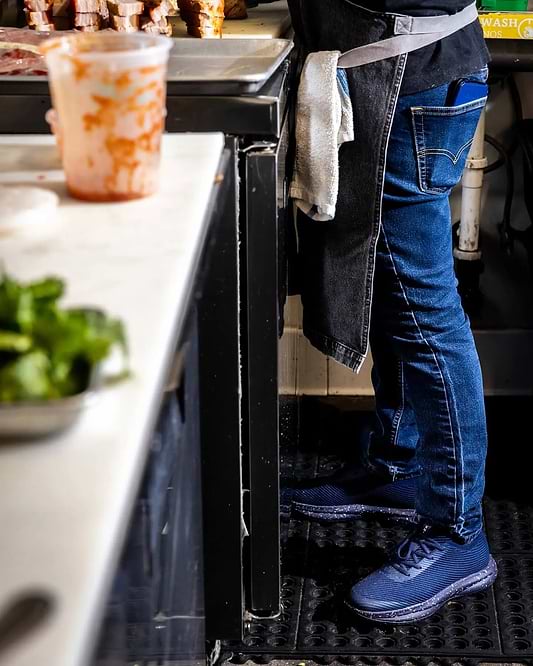
Prolonged Standing — Standing in one place for extended periods at work. NIOSH links prolonged standing with low back pain, physical fatigue, leg swelling, and muscle discomfort — making footwear selection especially consequential for workers in standing-heavy roles like line cooking or bedside nursing.
R
Rubber Outsole — An outsole made from rubber, chosen for work shoes because rubber provides reliable grip across a range of floor surfaces and holds up under repeated contact. Non-slip rubber outsoles are particularly common in kitchen and healthcare footwear where floor conditions change frequently.
S
Slip Resistance — The ability of footwear to reduce slip risk on tested surfaces and in the presence of contaminants like water, oil, or cleaning solution. Meaningful slip-resistance claims are backed by standards-based testing rather than general marketing language, and real-world performance still depends on floor type and conditions.
SR-Rated — Shorthand indicating that a shoe's slip resistance has been evaluated under a recognized test or performance framework, typically referencing ASTM F2913 and/or F3445. More informative than "non-slip" alone, though not a guarantee of slip-proof performance in every real-world condition.
Stability — How well a shoe keeps the foot balanced and controlled during movement and standing. Shoes that prioritize only softness without structural stability can feel less dependable during long shifts, particularly on smooth floors or during quick lateral movements.
T
Toe Box — The front section of a shoe that surrounds the toes. A roomy toe box helps prevent compression and discomfort during long shifts, when feet tend to swell slightly — a shoe that feels fine at the start of a shift can become uncomfortably tight by the end if the toe box is too narrow.
Tread Pattern — The arrangement of grooves and lugs on the outsole that channel liquids away from the contact surface and help maintain grip. Tread pattern design directly affects how a shoe performs in wet, greasy, or freshly cleaned environments.
U
Upper — The portion of the shoe above the outsole that wraps and covers the foot. Upper material is one of the most consequential buying decisions in work footwear, because it determines breathability, cleanability, and water resistance — three factors that often require tradeoffs depending on the specific work environment.
V
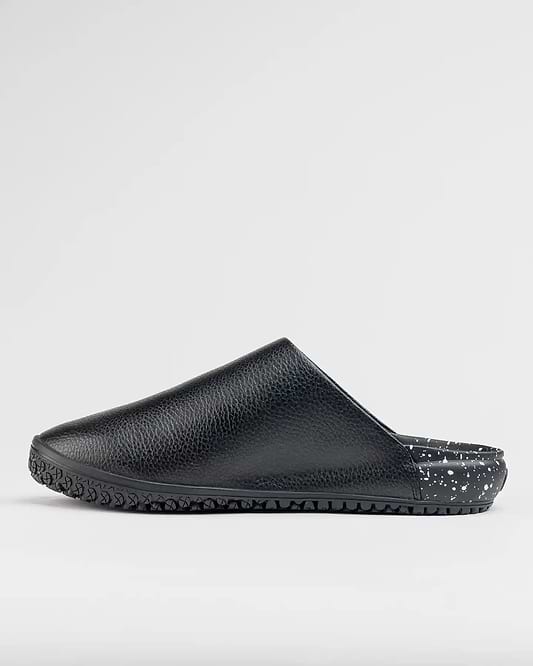
Vegan Leather — A synthetic alternative to animal leather used in some work shoes. Vegan leather uppers are often more water-resistant and easier to wipe clean than knit or mesh alternatives, making them a practical choice for spill-prone environments — and increasingly common in both kitchen and healthcare footwear.
W
Water-Resistant — Describes a shoe designed to shed spills and splashes without being built for full submersion. Most work-environment needs fall under water-resistant rather than waterproof — the real need is protection from day-to-day messes and splashes, not sustained exposure to standing water.
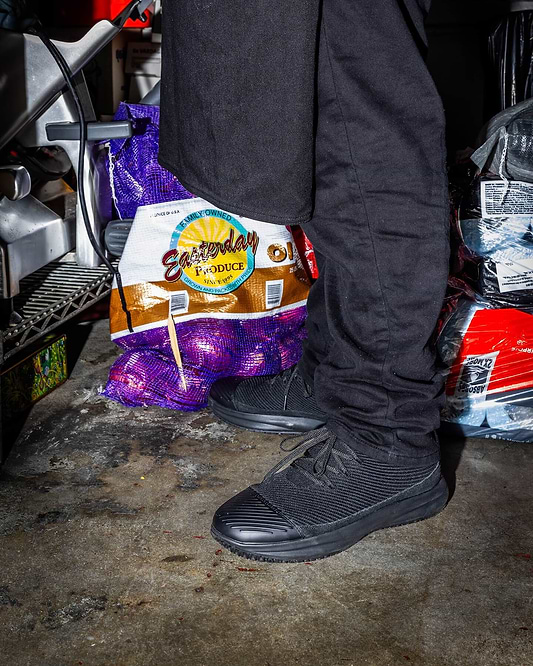
Work Shoe — Footwear built specifically for occupational use, balancing traction, support, durability, and practicality for demanding environments. Work shoes are designed with different priorities than athletic or casual footwear, with particular emphasis on slip resistance, cleanability, and long-shift performance.